Mondelez International (MDLZ)·Q4 2025 Earnings Summary
Mondelez Beats on Revenue and EPS, But Tepid 2026 Guidance Sends Stock Down 5% After Hours
February 3, 2026 · by Fintool AI Agent
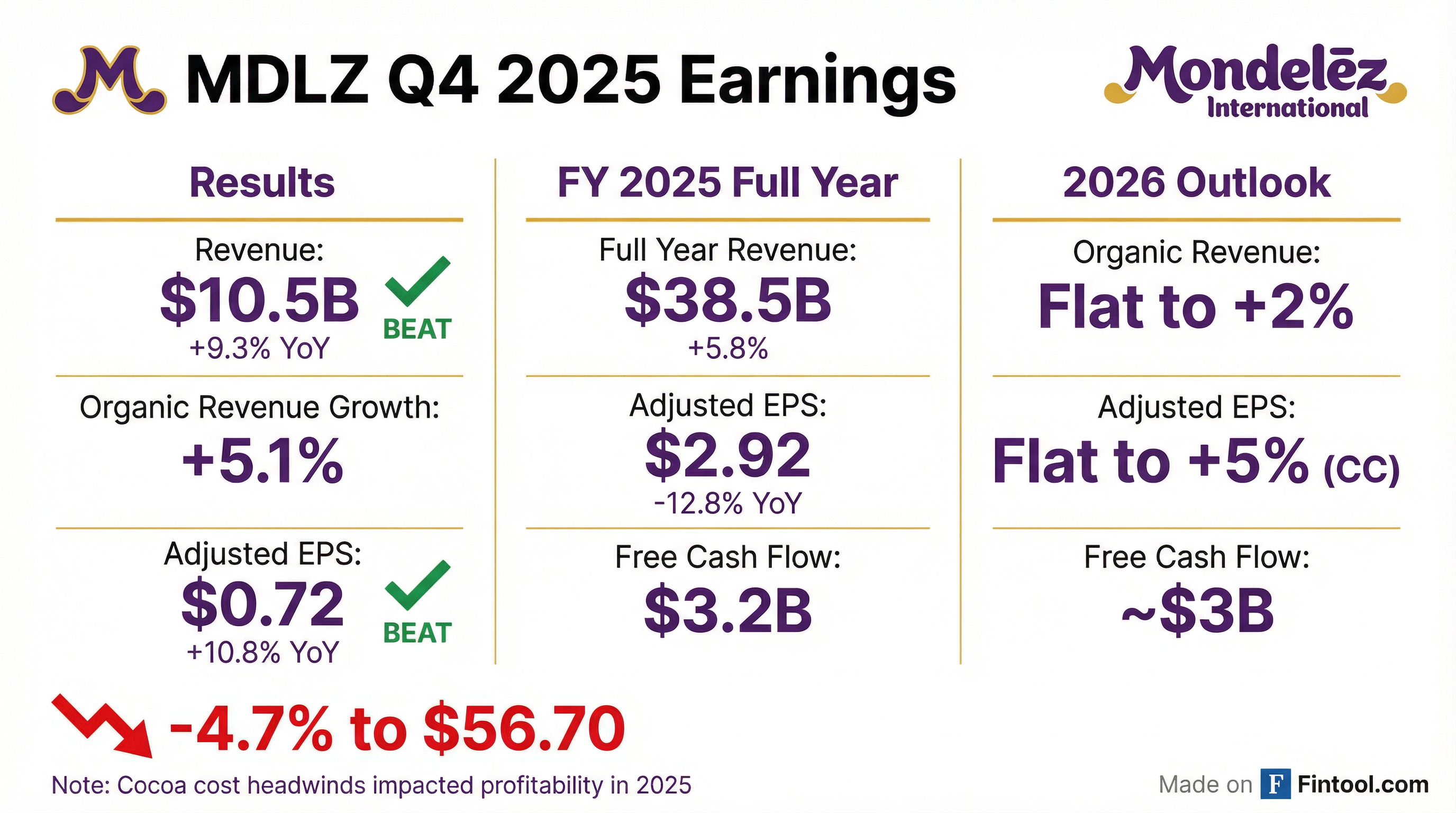
Mondelez International (NASDAQ: MDLZ) delivered a double beat in Q4 2025, posting revenue of $10.5 billion (+9.3% YoY) and adjusted EPS of $0.72 (+10.8% YoY), exceeding Wall Street estimates on both metrics. However, shares fell nearly 5% in after-hours trading after management guided for flat-to-low-single-digit growth in 2026, signaling that cocoa cost headwinds will continue to pressure margins.
The snacking giant delivered its eighth consecutive EPS beat, but investors focused on the cautious 2026 outlook and continued volume weakness, with volume/mix declining 4.8% in Q4 despite aggressive pricing actions.
Did Mondelez Beat Earnings in Q4 2025?
Yes, Mondelez beat on both revenue and EPS. Here's the breakdown:
*Values retrieved from S&P Global
Revenue growth was driven by higher net pricing (+9.9 percentage points) partially offset by unfavorable volume/mix (-4.8 percentage points). Organic net revenue grew 5.1%, with emerging markets leading at +8.0% organic growth.
The large gap between adjusted EPS ($0.72) and GAAP EPS ($0.51) reflects a $231 million mark-to-market loss on commodity and foreign currency derivative contracts during the quarter.
 Ask Fintool AI Agent
What Did Management Say About 2025?
CEO Dirk Van de Put struck a cautiously optimistic tone, acknowledging the challenges while pointing to the company's strategic positioning:
"We delivered solid top-line results, generated strong cash flow, and returned significant cash to shareholders in a dynamic and challenging 2025 environment. While unprecedented cocoa cost headwinds impacted our profitability, our teams remained focused on what they can control to best position us for sustainable, profitable growth."
Full Year 2025 Highlights:
The year's profitability was heavily impacted by cocoa costs—adjusted gross profit declined $1.57 billion at constant currency while adjusted gross profit margin contracted 580 basis points to 32.0%.
What Did Mondelez Guide for 2026?
Management provided modest guidance that disappointed investors:
Van de Put expressed confidence in the recovery trajectory:
"As 2026 commences, we are executing clear plans to create multi-year shareholder value through improved volumes, brand investments, structural cost savings and disciplined capital allocation coupled with stabilizing cocoa costs. We remain convinced that our scale across markets—along with our stable of iconic brands, extensive route-to-market capabilities and supply chain strength—give us fundamental advantages in the years to come."
Important caveat: The guidance does not reflect any potential tariff changes to USMCA-compliant trade, and management flagged "greater than usual volatility" from geopolitical, trade, regulatory, and commodity uncertainties.
2026 Phasing—Key Detail: CFO Zaramella flagged a $500 million headwind concentrated in H1 2026 (predominantly Q1) due to inventory accounting adjustments. The company must mark 2026 opening inventory to the higher pipeline cocoa cost locked in for 2026 versus where they exited 2025. This creates a "dislocation of costs" between first and second half. Expect a sequential improvement in volume, revenue, and EBIT as the year progresses.
Guidance Flexibility: The wide guidance range (0-2% organic revenue, flat-to-5% EPS) is intentionally prudent because "recent and sudden cocoa dynamics might require some adjustments and flexibility depending on how competitors will react to those prices."
2026 Strategic Actions by Region:
Management expressed strong confidence in 2027 EPS growth, expecting actions in Developed Markets combined with recent cocoa price trends to drive meaningful improvement.
How Did the Stock React?
MDLZ shares closed the regular session at $59.47, up 2.4% ahead of the earnings release. However, the stock sold off sharply after hours, trading down to $56.70—a decline of approximately 4.7% from the close.
Context: The stock is trading 22.6% below its 52-week high of $76.87, reflecting investor concerns about margin compression from cocoa costs and volume weakness. The aftermarket reaction suggests the market was not satisfied with the muted 2026 outlook despite the Q4 beat.
Historical earnings reactions:
- Q3 2025: Beat EPS by 7.9%, stock fell 2.3%
- Q2 2025: Beat EPS by 12.2%, stock rose 1.8%
- Q1 2025: Missed EPS by 0.5%, stock fell 3.1%
- Q4 2024: Beat EPS by 16.6%, stock rose 2.3%
Ask Fintool AI AgentWhat Changed This Quarter?
Q4 vs Q3 2025 — Key Shifts:
The key change: volume declines accelerated in Q4 while pricing increased further. Europe saw the most pronounced dynamic—volume/mix was -7.4% while pricing contributed +15.7 percentage points, suggesting aggressive price increases are driving significant consumer pushback.
On the positive side, adjusted operating income margin improved 190 basis points sequentially to 11.9%, driven by lower advertising and consumer promotion costs, manufacturing productivity, and lower overhead costs.
How Did Categories Perform?
The category breakdown reveals sharply divergent dynamics across Mondelez's portfolio:
Q4 2025 Category Performance:
Key category insight: Chocolate's +11.4% organic growth was almost entirely pricing-driven to offset cocoa costs, resulting in the steepest volume decline (-9.4 pp). Biscuits—the largest category at 48% of revenue—barely grew organically (+0.1%), weighed down by US consumption softness.
Innovation Bright Spot: Management highlighted the Biscoff collaboration as "very successful in 2025, but it really is going to go to the next level in 2026." This anchor innovation, combined with expanded price pack architecture and increased brand investment, forms the core of their European chocolate recovery strategy.
Market Share Pressure: The share of revenue in categories where Mondelez is gaining or holding share fell from ~50% in 2024 to ~40% in YTD 2025, reflecting the impact of aggressive pricing on competitive positioning.
How Did Regions Perform?
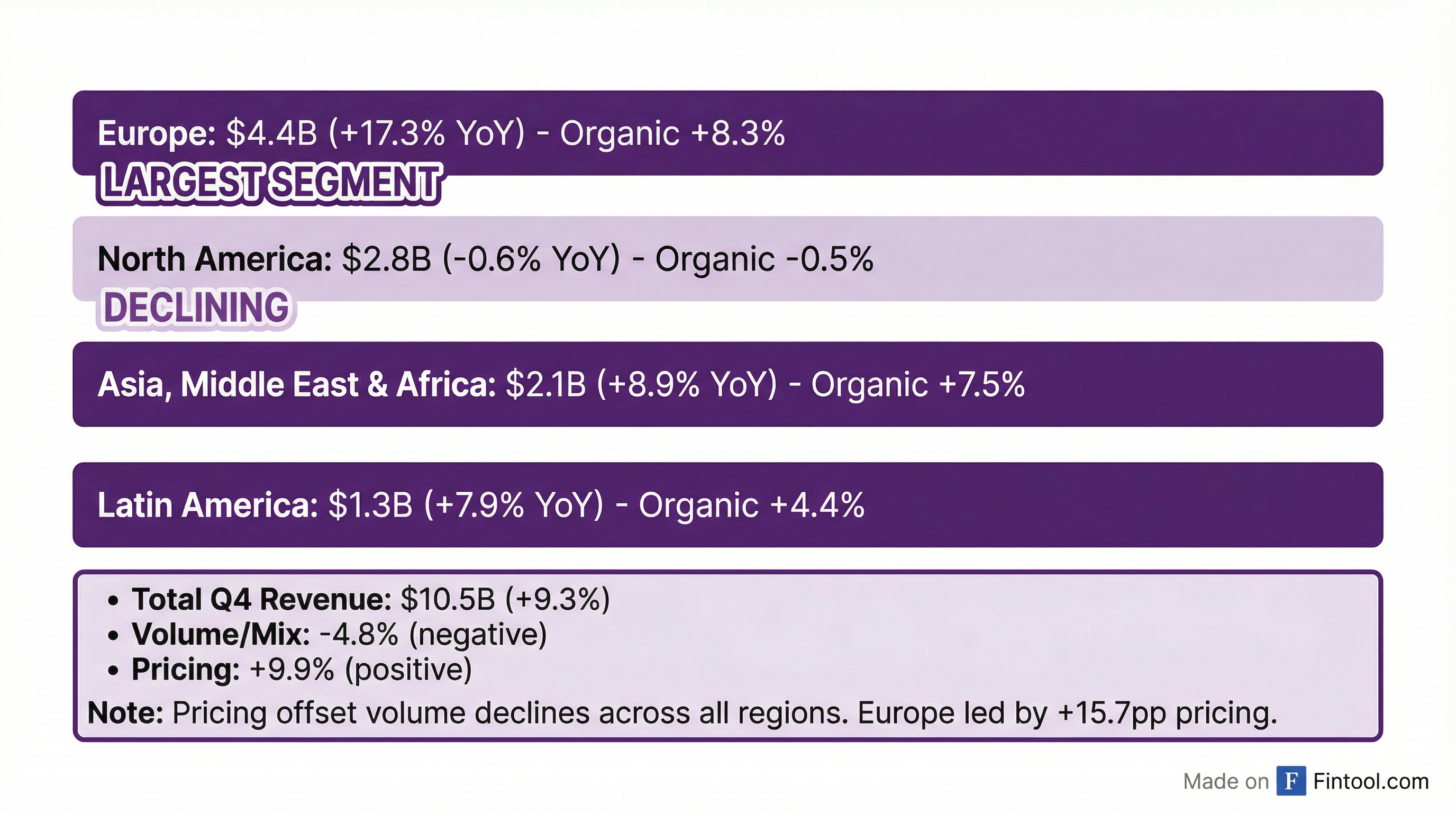
Q4 2025 Regional Performance:
Europe was the standout, contributing 42% of total revenue and growing 17.3%, though this was almost entirely pricing-driven as volume/mix declined 7.4 percentage points.
North America remains the weak spot, declining 0.6% with organic revenue down 0.5%. The region saw the smallest pricing contribution (+3.2 pp) while still experiencing volume declines of 3.7 percentage points.
CEO Van de Put provided extensive color on the challenging North American consumer:
"The consumer confidence is near historic low. They're worried about overall affordability. They are fed up with the price increases. They don't feel good about their personal economic outlook. They doubt about job security... The average shopping basket of the consumer in the U.S., whether you're in the higher or in the lower social economic classes, has not increased for the last 2-3 years. Within that basket, they've spent more money on the basics: milk, meat, bread, and so on. And as a consequence, snacking is being affected."
Management noted that premium offerings like Perfect Bar, Tate's, Hu chocolate, and Builder's Bar are growing double digits, while they remain underindexed in value/club channels where consumers are shifting.
Emerging vs Developed Markets:
Emerging markets continue to outperform, driven by stronger pricing power (+11.8 pp) despite volume declines of 3.8 percentage points.
Q&A Highlights: What Did Analysts Ask?
The earnings call Q&A session revealed several key insights not in the prepared remarks:
On the $500M H1 2026 Cost Headwind:
"The way our inventory accounting works is that we will have to adjust the level of inventory in the first day of the year to the actual pipeline cost that we see in 2026 versus how we exited the year in 2025. That is a one-time adjustment... causing, in the first two quarters, but predominantly in Q1, an impact that is $500 million."
On Not Matching Competitor Price Cuts:
"We started off 2025 quite aggressive on promotions and on deals, working on price. I have to say it didn't give us a return on our investments. So in the second half of 2025, we changed our strategy... Overall, I would say that probably was better for us. We don't necessarily think that we need to decrease our prices to the magnitude that I heard from another company."
On GLP-1 Drug Impact (New):
"If we expand 10 years and we take an adoption rate in the U.S., which would be somewhere between 10% and 20%, and even then, we do not see a significant effect on our overall business. We believe that over that period of time, it could have a 0.5%-1.5% effect on our overall volumes. So almost negligible over a period of 10 years."
On Lab-Grown Cocoa Investments:
"I think over time, there will be more and more lab-grown cocoa that will become available, not GMO, but lab-grown. And we think that there will be an interest from the European Commission and the U.S. government to approve that sort of cocoa... that's also a direction that we are investing in and supporting."
On 2027 Outlook:
"We are aiming for a strong EPS growth in 2027. But at the same time, we want to keep on investing in our brands. We are not planning to flow everything to the bottom line."
Management also noted they will provide significantly more detail on their European chocolate strategy and North American plans at the upcoming CAGNY Conference.
Ask Fintool AI AgentWhat's the Cocoa Outlook?
Cocoa prices are finally coming down, but remain well above historical levels:
London Cocoa Price Trajectory (GBP/ton):
Key cocoa dynamics:
- A surplus is expected in the 25/26 crop due to favorable weather in West Africa, continued Rest of World growth, and demand elasticity
- Industry covered majority of 2026 cocoa before the latest market price correction
- Mondelez has the vast majority of 2026 cocoa hedged
This suggests margin relief may be more meaningful in 2027 than 2026, as the industry locked in 2026 coverage at higher prices before the recent market correction.
CFO Luca Zaramella noted that cocoa's rapid decline "happened all of a sudden" in the last couple of weeks, and "we would have liked a little bit more of a balanced approach to the way down." At current levels (~£3,000), he believes cocoa "is a fairer representation of supply and demand" and that "this level is important for us to realize as we look at profitability, particularly going forward into 2027 and beyond."
Supply Chain Diversification: Management is actively investing in cocoa sourcing outside West Africa—primarily Ecuador and Brazil in Latin America, plus India and Indonesia in Asia. The goal is to reduce concentration risk given that Ghana and Ivory Coast currently represent 60%-65% of global cocoa supply.
What Are the Key Risks?
Management's outlook includes several risk factors worth monitoring:
-
Tariff Uncertainty: The 2026 guidance explicitly excludes potential tariff changes to USMCA-compliant trade. Any new tariffs on Mexico or Canada could materially impact North American operations.
-
Cocoa Cost Volatility: While management expects "stabilizing cocoa costs" in 2026, they hedged most of 2026 before prices fell. The company cited "volatility of cocoa and other commodity input costs" as a primary risk factor.
-
Consumer Pushback on Pricing: Volume/mix was negative in all four regions, suggesting consumers are pushing back on price increases. Further pricing may not be sustainable without additional volume erosion.
-
Currency Exposure: A significant portion of operations are outside the U.S., and management flagged "changes in currency exchange rates, controls and restrictions" as a material risk.
-
ERP System Implementation: The company is mid-way through a multi-year ERP implementation program expected to complete by year-end 2028, with ongoing costs impacting results.
Ask Fintool AI AgentCapital Allocation and Balance Sheet
FY 2025 Capital Returns: Mondelez returned $4.9 billion to shareholders through dividends and share repurchases, demonstrating commitment to capital returns despite profitability headwinds.
Balance Sheet (December 31, 2025):
Net debt increased $2.68 billion year-over-year to $19.08 billion, reflecting the acquisition of Evirth and continued capital returns.
Cash Flow (FY 2025):
Free cash flow declined 8.2% to $3.24 billion, but still comfortably covered the $2.49 billion in dividends paid during the year.
Forward Catalysts
Looking ahead, key events and factors to watch:
-
CAGNY Conference (February 2026): Management promised to go "deeper" on European chocolate strategy, North American plans, and the 2027+ outlook.
-
Q1 2026 Earnings (Late April 2026): First read on whether volume trends are stabilizing. Expect profit headwinds from the $500M inventory accounting adjustment.
-
Competitor Pricing Behavior: Management flagged "potential competitive reaction" to falling cocoa prices as the key variable in their guidance range. Watch for pricing moves from Hershey, Nestle, and private label.
-
Cocoa Cost Trajectory: If cocoa stabilizes at ~£3,000 or lower, 2027 margin recovery could be significant. Management expects to "increase its margin in a considerable way" in 2027.
-
Tariff Announcements: Any changes to USMCA trade terms could materially impact the outlook—explicitly excluded from guidance.
Related Links: